
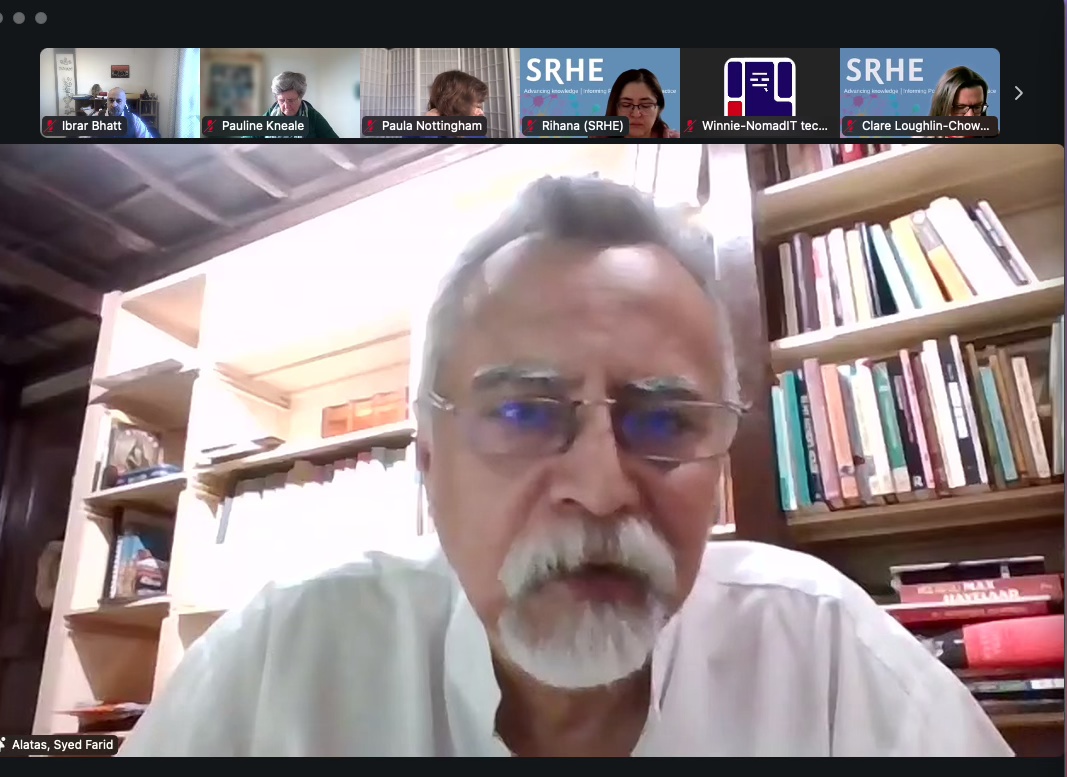
Please note: This is an updated post with the link to the recording below
On Monday 2 December 2024, during the online segment of the 2024 SRHE annual conference, Professor Farid Alatas delivered a thought-provoking keynote address in which he emphasised an urgent need for the decolonisation of knowledge within higher education. His lecture was titled ‘The captive mind and anti-colonial thought’ and drew from the themes of his numerous works including Sociological Theory Beyond the Canon (Alatas, 2017).
Alatas called for a broader, more inclusive framework for teaching sociological theory and the importance of doing so for contemporary higher education. For Alatas, this framework should move beyond a Eurocentric and androcentric focus of traditional curricula, and integrate framings and concepts from non-Western thinkers (including women) to establish a genuinely international perspective.
In particular, he discussed his detailed engagement with the neglected social theories of Ibn Khaldun, his efforts to develop a ‘neo-Khaldunian theory of sociology’. He also highlighted another exemplar of non-Western thought, the Filipino theorist José Rizal. Alatas discussed how such modes sort of non-Western social theory should be incorporated into social science textbooks and teaching curricula.
Professor Alatas further argued that continuing to rely on theories and concepts from a limited group of countries—primarily Western European and North American—imposes intellectual constraints that are both limiting and potentially harmful for higher education. Using historical examples, such as the divergent interpretations of the Crusades (viewed as religious wars from a European perspective but as colonial invasions from a Middle Eastern perspective), he illustrated how perspectives confined to the European experience often fail to account for the nuanced framing of such events in other regions. Such epistemic blind spots stress the need for higher education to embrace diverse ways of knowing that have long existed across global traditions.
Beyond critiquing Eurocentrism, Professor Alatas acknowledged the systemic challenges within institutions in the Global South, which also inhibit knowledge production. He urged for inward critical reflection within these contexts, addressing issues like resource constraints, institutional biases, racism, ethnocentrism, and the undervaluing of indigenous epistemologies through the internalisation of a ‘captive mindset’. Only by addressing these intertwined challenges, he concluded, can universities foster a more equitable and inclusive intellectual environment, and one that is more practically relevant and applicable to higher education in former colonised settings.
This keynote was a call to action for educators, researchers, and institutions to rethink and restructure the ways in which sociological and other academic canons are constructed and taught. But first, there is an important reflection that must be undertaken, and an acknowledgement, grounded in epistemic humility, that there is more to social theory than Eurocentrism.
There was not enough time to deeply engage with some of the concepts in his keynote; therefore, I hope to invite Professor Farid Alatas for an in-person conversation on these topics during his visit to the UK in 2025. Please look out for this event advertisement.
The recording is taken from the SRHE YouTube channel. The original link is here: https://youtu.be/4Cf6C9wP6Ac?feature=shared
You can watch the rest of the conference plenaries here: https://srhe.ac.uk/2024-plenaries/
Categories: academia, books, conferences, decolonisation, epistemology, higher education, keynote, Lectures, religion, Research, SRHE





 Ibrar's space
1 reply »