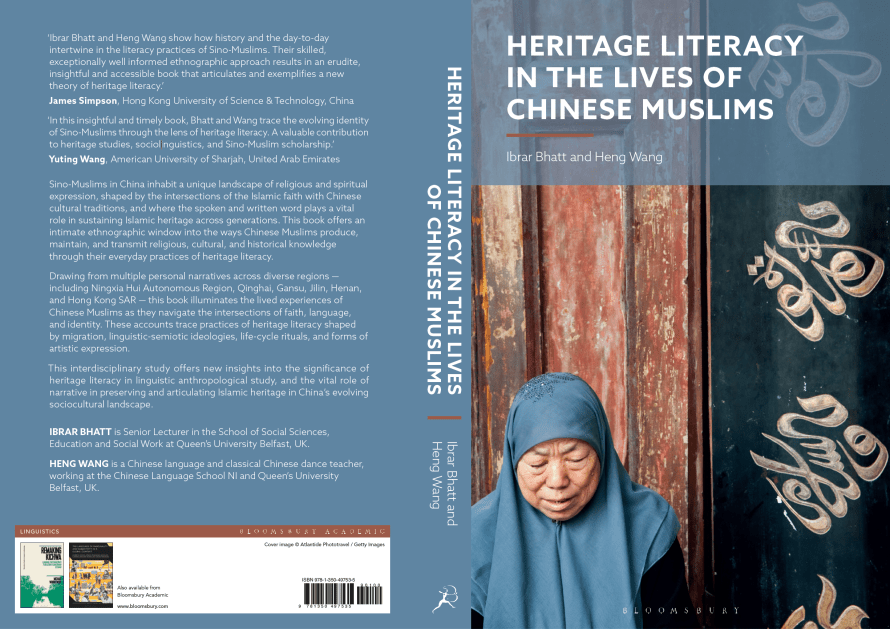
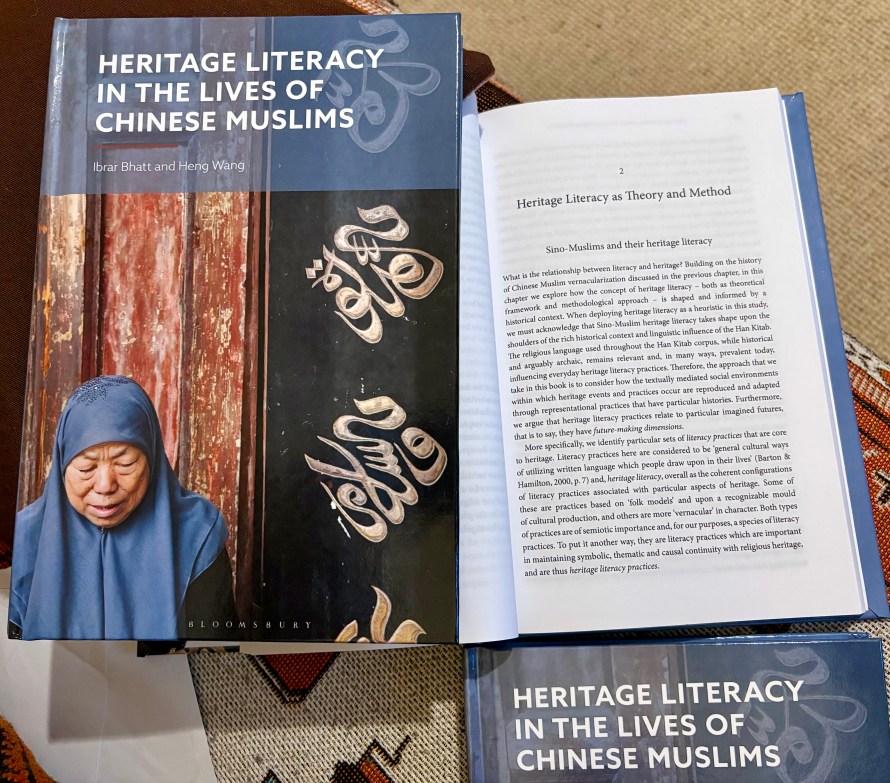
I’m delighted to share that my book, co-authored with Heng Wang, Heritage Literacy in the Lives of Chinese Muslims, will be published by Bloomsbury in April 2026 (see here). The book grows out of sustained ethnographic fieldwork across China, and from a developing programme of research on language, Islam, and heritage that spans several years.
A linguistic ethnography of heritage literacy
The book is based on fieldwork conducted across diverse regions of China. Drawing from multiple personal narratives across Ningxia Hui Autonomous Region, Qinghai, Gansu, Jilin, Henan, and Hong Kong SAR, we explore how Chinese Muslims produce, maintain, and transmit religious, cultural, and historical knowledge through their everyday practices of heritage literacy.
Sino-Muslims in China inhabit a unique landscape of religious and spiritual expression, shaped by the intersections of Islamic faith with Chinese cultural traditions. In these spaces, spoken and written language practices, across Arabic, Sinitic varieties, and other semiotic systems, play a vital role in sustaining Islamic heritage across generations.
Through in-depth personal narratives, we examine how individuals navigate the intersections of faith, language, identity, migration, ritual life, and artistic expression. We felt strongly that foregrounding the voices of Chinese Muslims themselves would be a meaningful and necessary contribution to the literature. Rather than speaking about communities in abstract terms, this book listens carefully to and draws from lived experience.
Extending a trajectory of scholarship
This book continues and deepens our trajectory of scholarship on heritage, language, and Muslim communities in Chinese contexts. It extends earlier work including Bhatt and Wang (2023), Bhatt (2023), Bhatt and Li (2024) in the Hong Kong context, and broader theorising in Bhatt et al. (2025).
Across these publications, we have been developing the concept of heritage literacy as a way of understanding how language practices mediate religious continuity, identity formation, and intergenerational transmission. In this new book, we conceptualise and apply the theory of heritage literacy in much greater detail, demonstrating how it operates in everyday religious, educational, and community settings.
Generous endorsements
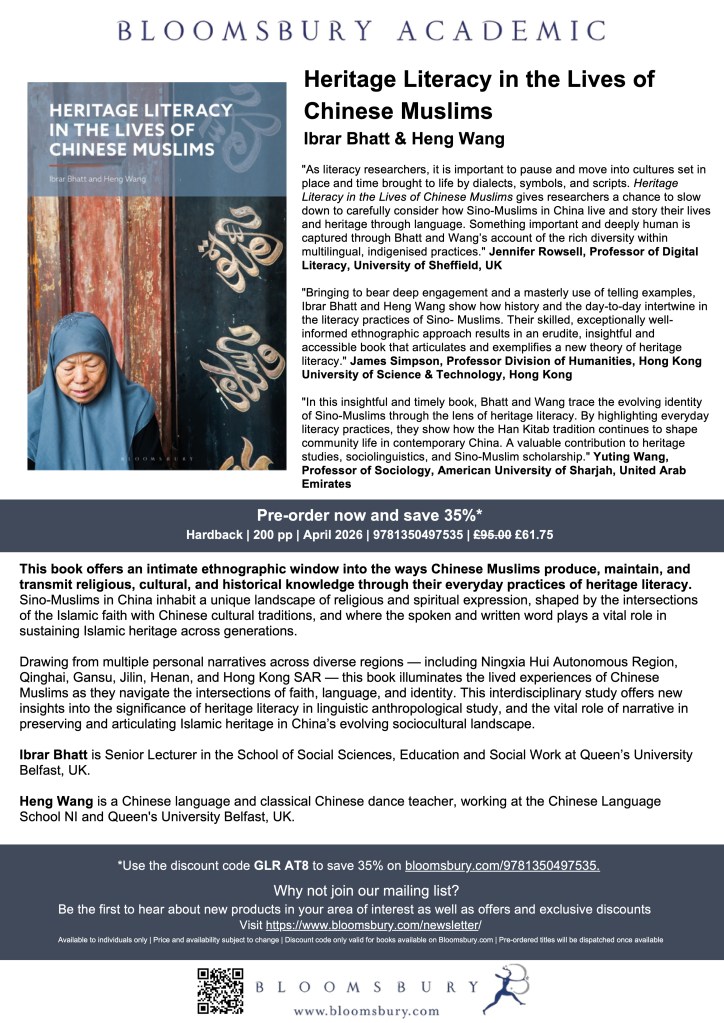
We are deeply grateful for the generous endorsements the book has already received:
“As literacy researchers, it is important to pause and move into cultures set in place and time brought to life by dialects, symbols, and scripts. Heritage Literacy in the Lives of Chinese Muslims gives researchers a chance to slow down to carefully consider how Sino-Muslims in China live and story their lives and heritage through language. Something important and deeply human is captured through Bhatt and Wang’s account of the rich diversity within multilingual, indigenised practices.”
Jennifer Rowsell, Professor of Digital Literacy, University of Sheffield, UK“Bringing to bear deep engagement and a masterly use of telling examples, Ibrar Bhatt and Heng Wang show how history and the day-to-day intertwine in the literacy practices of Sino-Muslims. Their skilled, exceptionally well-informed ethnographic approach results in an erudite, insightful and accessible book that articulates and exemplifies a new theory of heritage literacy.”
James Simpson, Professor Division of Humanities, Hong Kong University of Science & Technology, Hong Kong“In this insightful and timely book, Bhatt and Wang trace the evolving identity of Sino-Muslims through the lens of heritage literacy. By highlighting everyday literacy practices, they show how the Han Kitab tradition continues to shape community life in contemporary China. A valuable contribution to heritage studies, sociolinguistics, and Sino-Muslim scholarship.”
Yuting Wang, Professor of Sociology, American University of Sharjah, United Arab Emirates
Research support
The research underpinning this book has been made possible through the generous support of several funding bodies. The primary fieldwork was supported by: a Research Fellowship funded by the Leverhulme Trust, two small grants from the Faculty of Arts and Social Sciences at Queen’s University Belfast, and some Hong Kong data was collected through a subsequent British Academy grant. During the preparation of the manuscript, a further Leverhulme Trust research project grant was awarded for a study in Hong Kong and the Greater Bay Area. I (Ibrar Bhatt) am the Principal Investigator and award holder for all of these projects, with Heng Wang as co-researcher, and Dr Lee-Shan Tse serving as Research Fellow on the current Greater Bay Area project. We are sincerely grateful for this support.
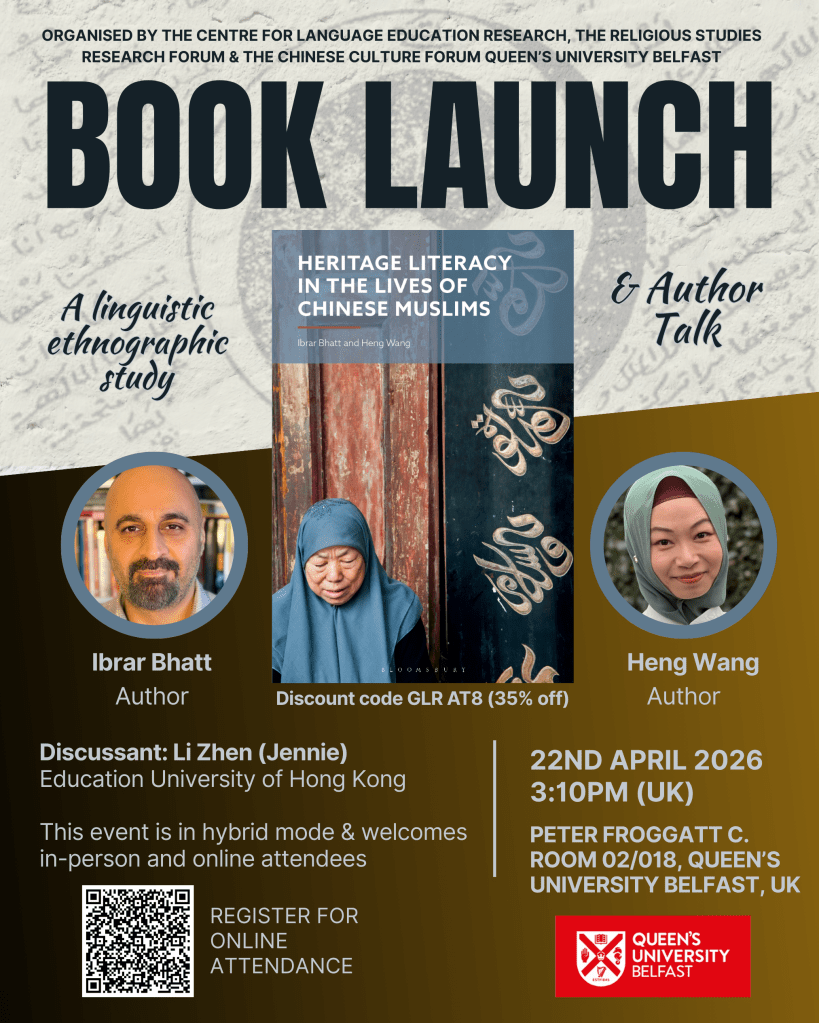
Book launch – Queen’s University Belfast
We are very excited to celebrate the book’s publication with a launch and author talk at Queen’s University Belfast:
22nd April 2026
3:10pm (UK time)
Peter Froggatt Centre, Room 02/018
Queen’s University Belfast
The event will run in hybrid mode, welcoming both in-person and online attendees. Registration details for online attendees is available through the QR code in the poster.
Looking ahead
Heng and I are genuinely excited about this book. We hope it not only advances theorisation around heritage literacy, but also opens space for further interdisciplinary conversations about language practices in religious contexts, especially in settings where identities are negotiated across complex cultural and political landscapes.
Most of all, we hope that the voices of the Chinese Muslims who so generously shared their stories will resonate with readers, and that their lived experiences will enrich scholarly understandings of literacy, heritage, and faith in China.





 Ibrar's space